
A working car made of LEGO?
What if we designed our own car instead of choosing from a manufacturer’s range? An idea for AI-assisted design, custom manufacturing and a community marketplace for car designs.
Over the past hundred years, the automotive industry has made incredible technological progress. Today we build electric cars that accelerate to a hundred kilometres per hour in a few seconds, travel hundreds of kilometres on a single charge, and are packed with electronics. Yet one thing has essentially remained unchanged: car manufacturers still decide what cars we can buy.
We walk into a showroom, choose a model, one of its trim levels, a colour, perhaps the upholstery and a few extras. We call this a car configurator. In reality, however, we are not configuring anything; we are simply choosing from options predefined by the manufacturer.
But why is it this way? Why can't I design exactly the car I want?
Why could car manufacturing change?
The answer, of course, lies in manufacturing technology and economics. A traditional car factory is built to produce a few predefined models in enormous quantities. Its tooling, production lines and supply chains are all optimised for this.
But I think this model will sooner or later change fundamentally. And electric cars and artificial intelligence could provide precisely the conditions needed for that change.
Designing an internal combustion engine is an extraordinarily complex engineering task. It requires solving countless problems in mechanics, thermodynamics, chemistry and materials science. An electric drivetrain is mechanically much simpler by comparison, and much of it can be standardised and assembled from modular components.
An electric motor, a battery and their electronics do not, of course, make a complete car. But the simplicity of electric propulsion opens up possibilities that would be much harder to realise in the world of internal combustion engines.
From configuration to your own design
And here is my idea.
Imagine a website that, at first glance, works like any car configurator today. Except that here we do not choose a BMW, Tesla or Mazda: we design our own car.
We would not have to work in an engineering CAD application. We would not need to understand mechanics, electrical engineering, structural analysis or manufacturing technology. We would simply use a visual interface to create the car we want.
We would choose the basic dimensions and body style, then freely shape its exterior. We could draw the lights, bumpers, roof and doors. Inside, we could tailor everything to our taste, from the seats and dashboard down to the smallest controls.
If, for example, I wanted a traditional car with analogue instruments, that is what I would design. If someone wanted a single enormous display in the cabin, they could make that. And if someone wanted a snap-in dashboard mount for a Raspberry Pi computer, with USB connectivity and its own display, they could do that too.
We would no longer have to adapt to manufacturers' often quite incomprehensible design decisions.
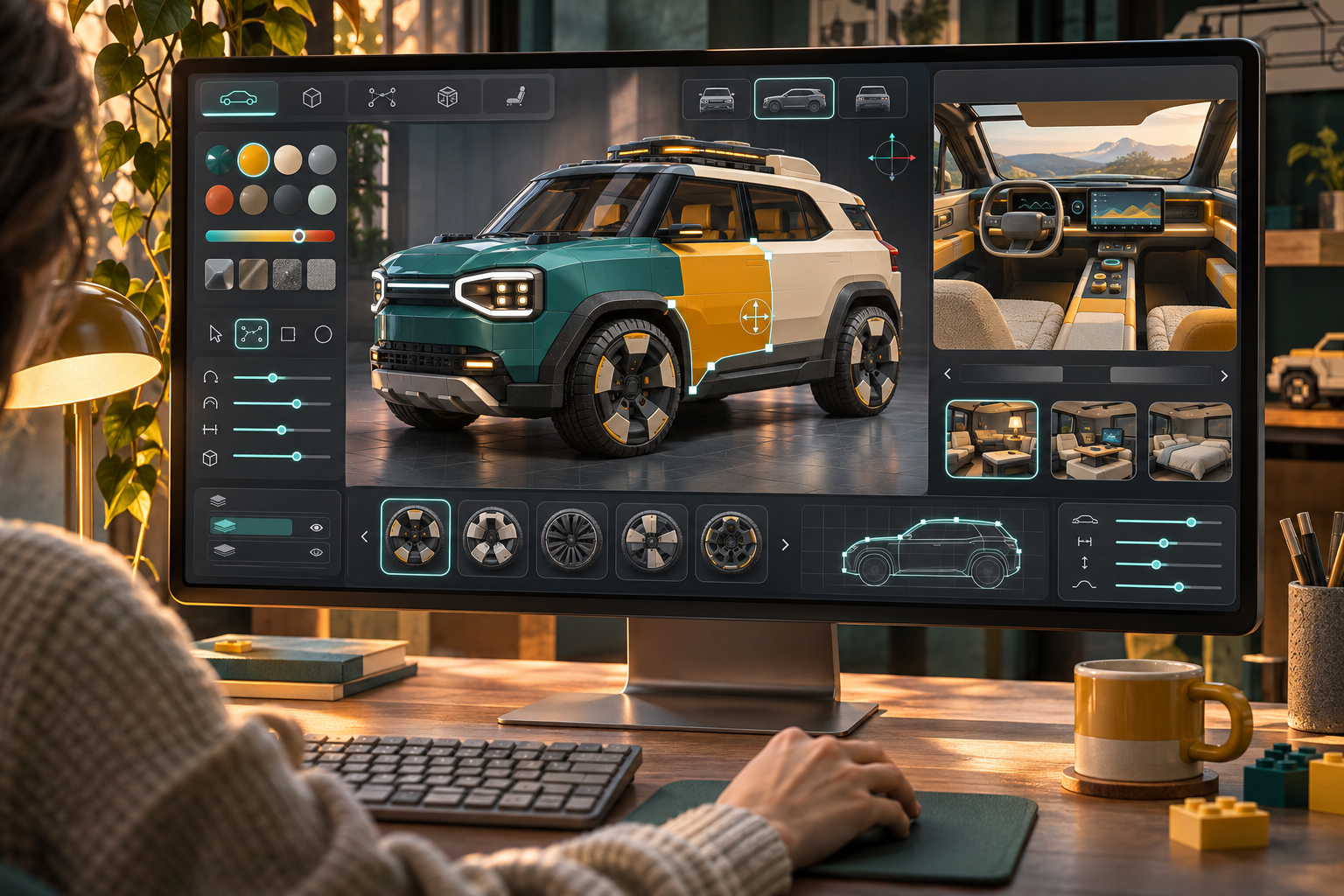
An AI engineer working in the background
Artificial intelligence would do the engineering work in the background.
When we drew something, the AI would not simply produce a three-dimensional model of it; it would design the actual construction. It would select suitable components from an enormous library and design the frame, electrical system, wiring, cooling, mechanical connections and every other necessary element.
The system would run simulations continuously. It would examine crash safety, structural rigidity, thermal loads, the electrical system, handling stability and manufacturability. If a requirement was not met, it would modify the construction and check it again. Before production, an engineer would also review the final plans, as is already common practice in automated electronics manufacturing.
The system would have another important component: automatic regulatory compliance checks.
At the start of the design process, we would specify the country in which we wanted to register the car. The system would apply that country's technical and legal requirements accordingly. If something did not comply, the AI would automatically suggest a modification or even resolve the problem. Arranging the necessary regulatory approvals would be part of the manufacturing process.
A custom car, made to order
And what would happen once we had finished the design?
We would press the Order button.
This is where a business model already visible in the electronics industry comes into play. At a company called JLCPCB, for example, we upload our own printed circuit board design, the system checks it, and the factory manufactures and sends it to us. We do not need to build our own factory, negotiate with suppliers or order thousands of units.
Why couldn't we do the same with cars?
Imagine a highly automated factory capable of producing electric cars of different sizes and designs, even as single-unit orders. The factory would not develop its own models; it would provide a manufacturing service.
The goal could be to complete our car within a month of placing the order.
A community marketplace for car designs
And now comes perhaps the most interesting part of the whole idea.
Why should everyone have to design their own car?
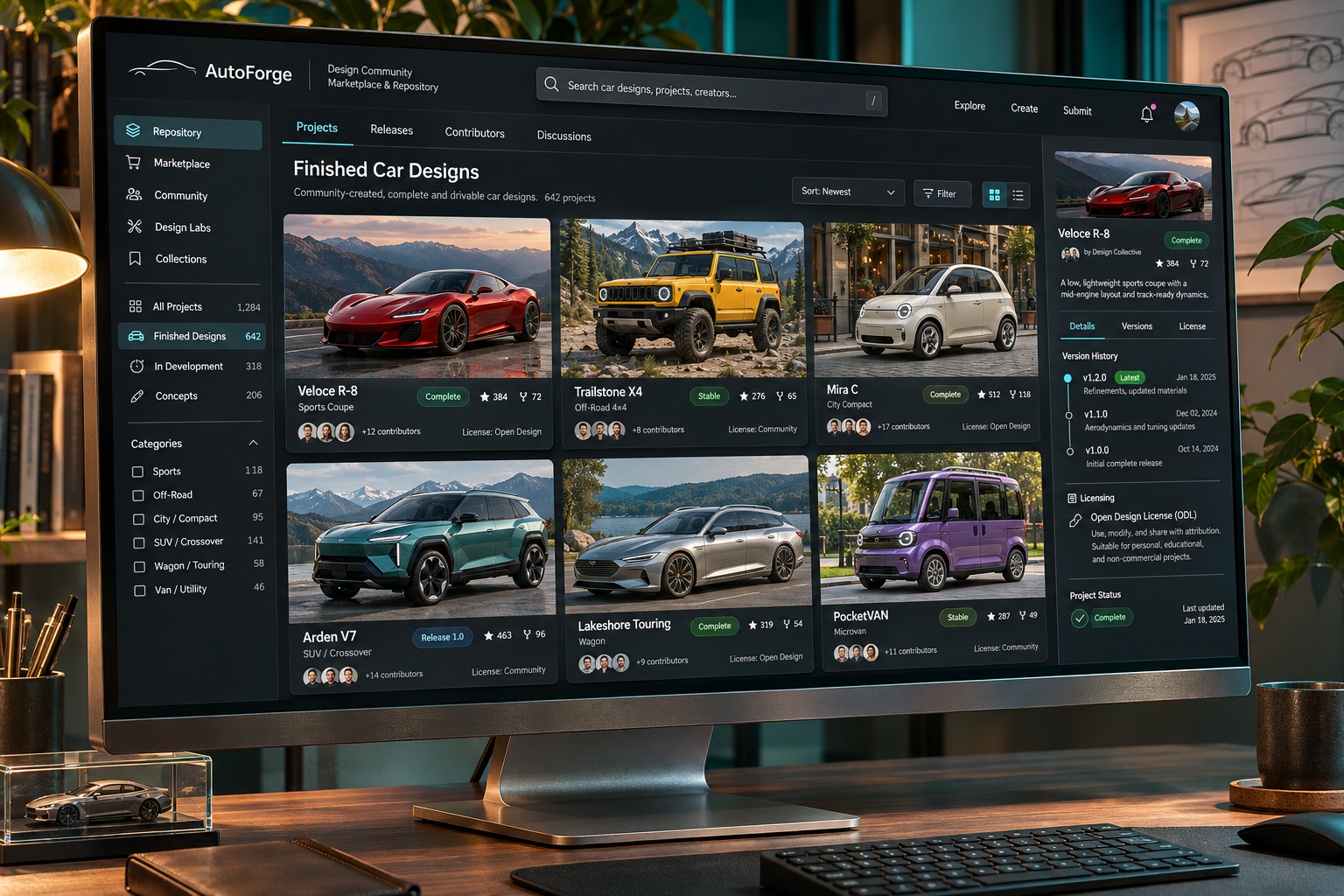
The system could include an enormous online marketplace where anyone could publish their designs. Not just engineers or professional automotive designers, but ordinary creative people too.
Someone might design a beautiful sports coupé, upload it to the library and set a fee of, say, 500 euros to use the design. Another creator might make an unusual off-roader, and a third a futuristic interior.
A buyer could select a design, pay the licence fee, then adapt it to their own needs.
The original designer could also specify which parts could be modified and which could not. They could lock particular body panels, proportions or design features while allowing complete freedom elsewhere.
The system would track the origin of designs, modifications and licence terms. If someone created something new based on another creator's design, royalties could be split automatically, provided the original licence allowed it.
A creative community could emerge like those we see today in software development, video game modding or 3D printing.
A popular designer could sell hundreds of cars without ever owning a car factory.
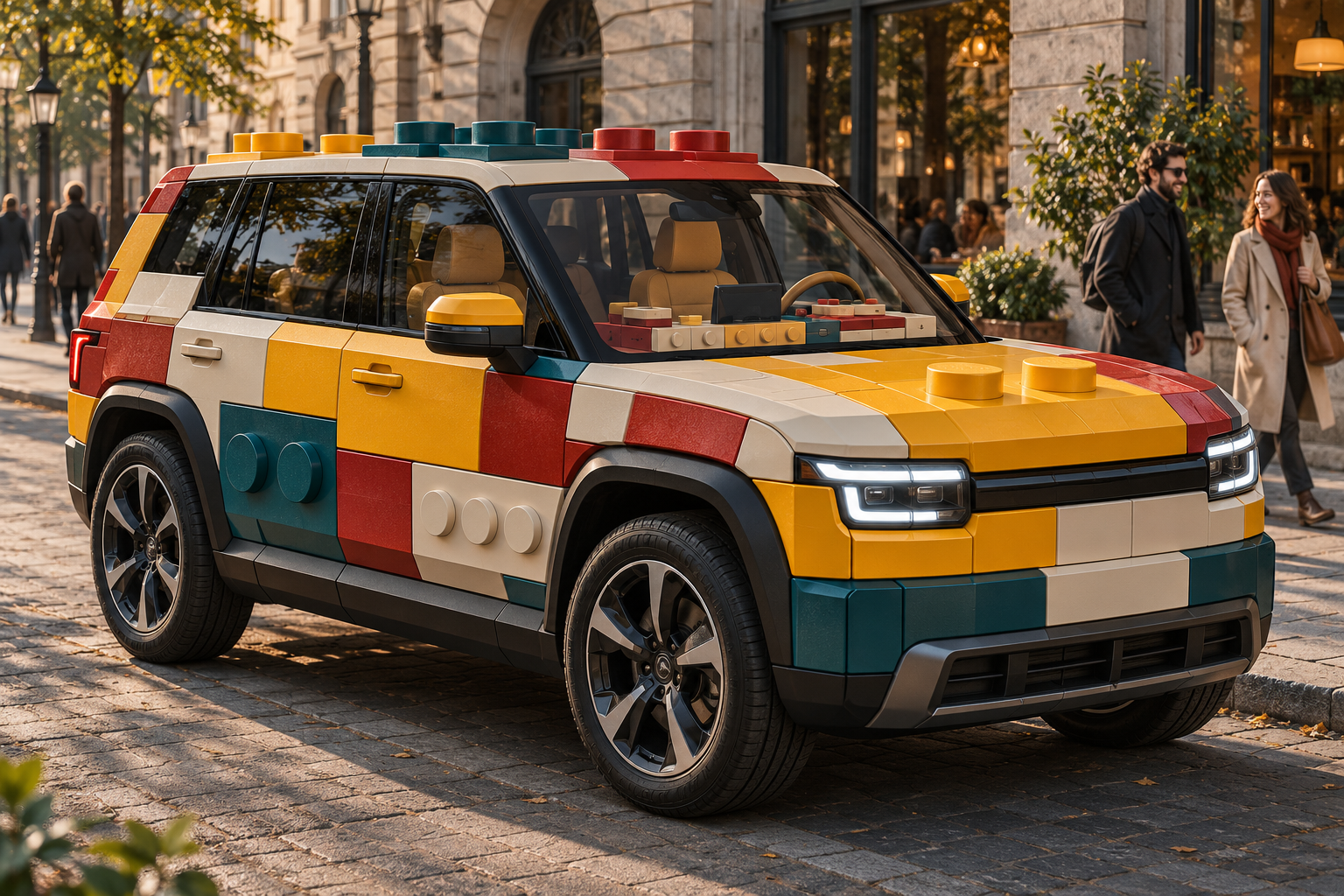
What if LEGO designed a car?
And that would only be the beginning.
Later, even the world's biggest brands could enter this marketplace.
Imagine, for example, that LEGO designed its own electric car.
It would not build a factory. It would not order thousands of cars. It would not maintain inventory. It would simply design a distinctive vehicle whose entire philosophy was built around modularity.
The cabin would have snap-in elements: interchangeable consoles, storage units, dashboard components, decorations and functional modules. The entire interior could work as a carefully designed building system.
LEGO would upload its design to the marketplace and charge, say, a 1,000-euro licence fee.
I could then choose this car, buy the design and customise it within the limits permitted by LEGO. The brand could specify which elements I could not change so that the result would still fit its visual identity.
And when I ordered the car, LEGO would automatically receive its licence fee.
All without having to manufacture or sell a single car in the traditional sense.
Brands, creators and interchangeable modules
The same could work with sports brands, fashion designers, video game developers, film studios or even well-known artists.
There could be numbered, limited-edition cars, digitally or physically signed by their designer. A famous designer's work would be more than a configuration: it would be a creation with value of its own.
What is more, customisation would not be limited to external appearance.
We could also establish standardised electronic and mechanical module bays within the system. There could be open interfaces, custom control panels, computers, displays and other accessories. In effect, cars could acquire a hardware and software ecosystem like the one computers have had for decades.
Why should we think in terms of car brands?
And here it is worth asking another question.
Why should we think in terms of car brands at all?
Today a car manufacturer is responsible for design, engineering, production, marketing and sales all at once. Yet these are entirely different activities.
In the system I imagine, they could be separated.
The platform would provide the design environment, artificial intelligence, component library, verification system and connection to manufacturing.
Designers and brands would provide the creative content.
Factories would build the actual vehicles.
And buyers would decide exactly what they wanted.
One of the biggest limitations of the current automotive model is precisely that manufacturers have to optimise for enormous production volumes. That is why we all end up with more or less the same cars.
I believe that, in the future, people should not have to adapt to mass production; production should adapt to people.
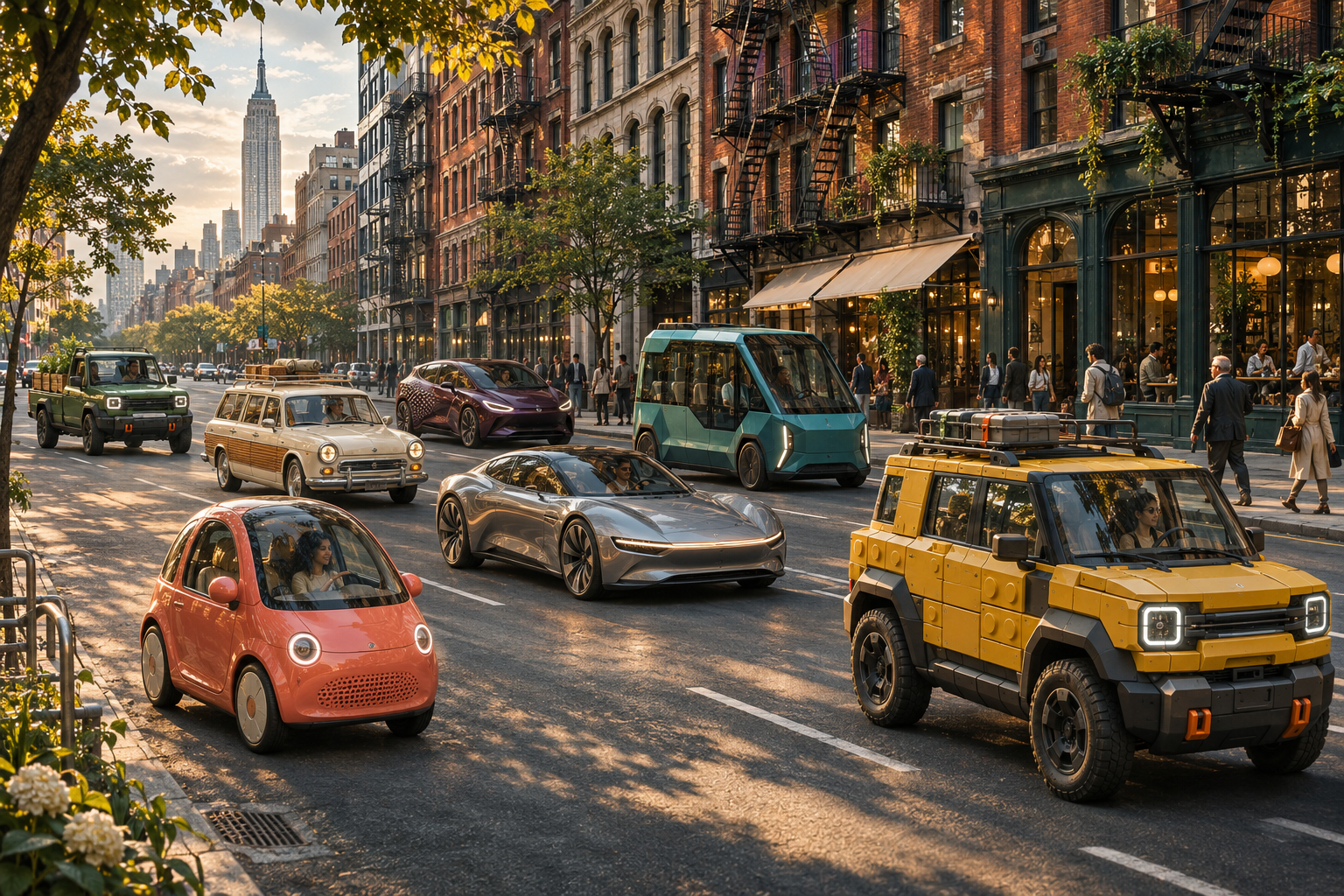
What kind of car would I like?
With advances in artificial intelligence, automated engineering design, modular electric drivetrains and flexible manufacturing technologies, this seems less and less impossible.
The idea of designing my car on a website and having it arrive outside my house a month later may still sound too ambitious today. But a few decades ago, it would also have sounded strange for an individual to design an electronic circuit at home, upload it to the internet and have a distant automated factory manufacture it within a few days.
I think the question is not whether such a system is technologically conceivable, but when we will reach the point where it becomes feasible.
And if we do get there, perhaps buying a car will finally stop being a question of whether I want a BMW, Mercedes, Tesla or some other brand.
It will simply be a question of what kind of car I want, and designing it myself.