
AI in a glass cube
What if we could simply snap an AI model into the motherboard?
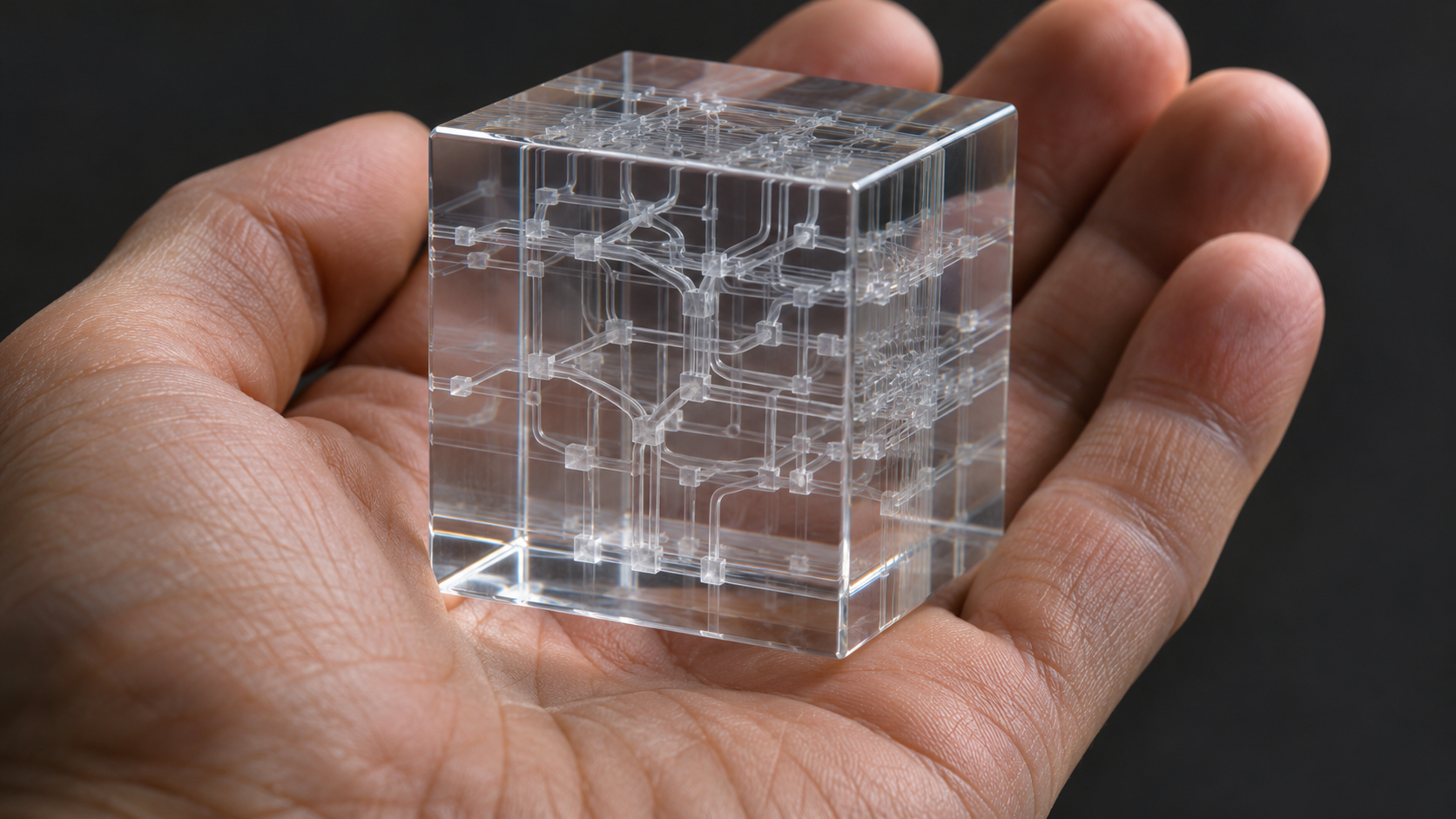
What if we could simply snap an AI model into the motherboard?
For a while now, I have been wondering whether computers for artificial intelligence really have to be built the way we currently imagine them. We have a model with weights, we store those weights as data, and then a processor performs the corresponding operations. We build ever more powerful hardware for this. What interests me, though, is how the computation itself could be implemented differently.
What if the weights were carried by the physical properties of a material? What if the input signal passed through a structure that inherently performed the desired transformation on it?
That was the starting point for my idea of an optical AI brain.
Imagine thin layers of glass or sapphire, with tiny structures formed inside them using a laser. Stacking them would give us a small, transparent cube. The internal design of the layers would determine how light passes through them, how its direction and phase change, and how the waves meet and interact.
We would feed the input into it as light. Sensors on the other side would measure the resulting output. In between, the structure of the material itself would perform the intended transformation.
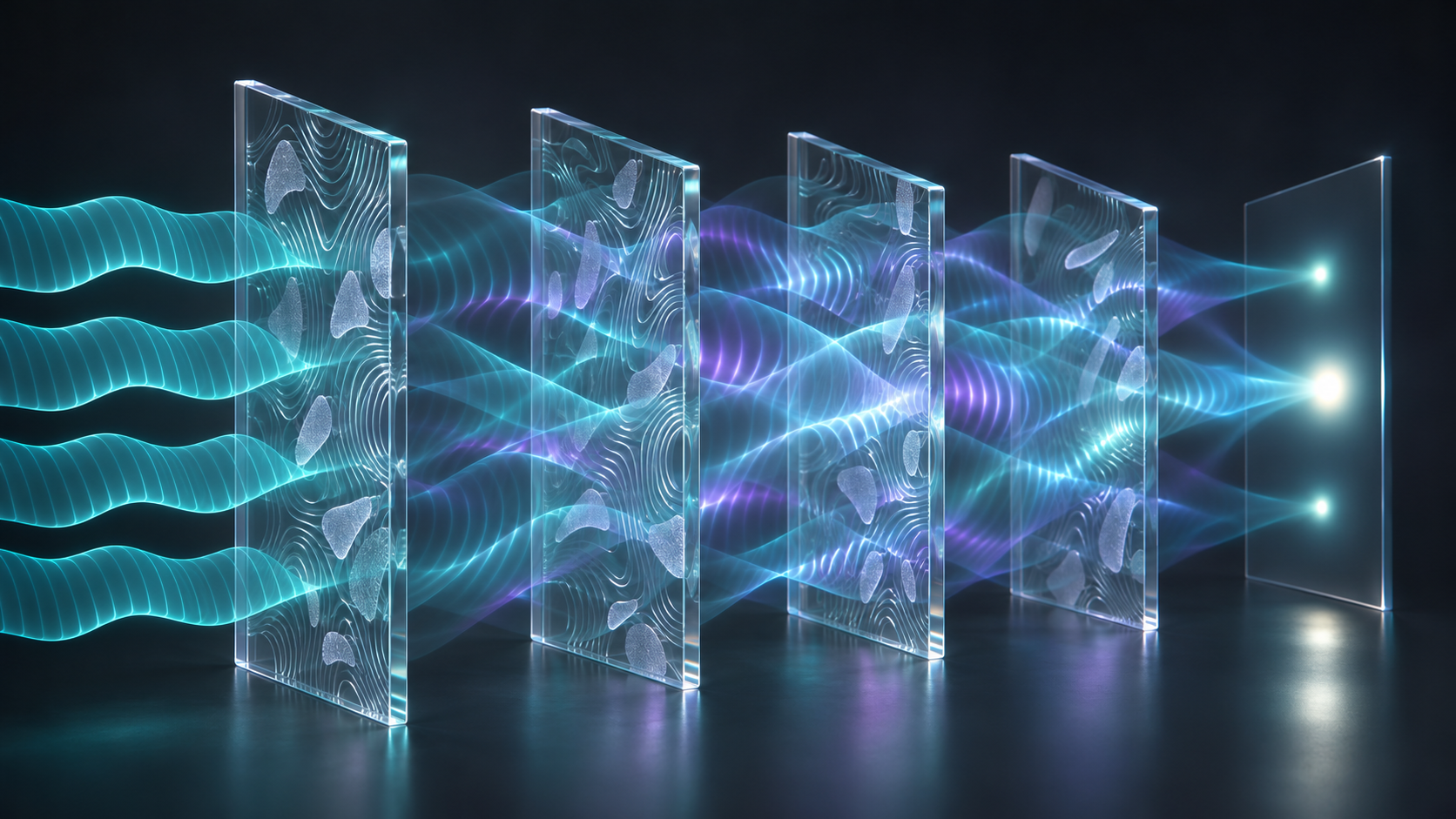
In this concept, the model would have a physical form. The connections and weights would be embodied in the internal structure of the glass. Just as the shape of a lens determines how it gathers light, this much more complex structure would transform the input signal in a particular way. How large and capable a neural network we could build from this is part of the engineering challenge still to be solved.
The rest of the computer could comfortably remain digital. Conventional electronics could generate the input, handle control, and process the output. My main interest is whether we could entrust the core computation to wave propagation.
I imagined the finished product as a replaceable model cube that fits into a socket on the motherboard. A new model comes out, you buy it, take out the old one, and snap in the new one. In this version, updating a model would take on a very tangible meaning.
Of course, this immediately raises a whole host of questions. How do we translate a trained network into an optical structure that can actually be manufactured? How precisely does it need to be made? How do we handle manufacturing variations? Where and how do the nonlinear steps required by the network take place? A glass cube on its own does not give us a complete AI system.
The possibility of a holographic design also occurred to me. It would be interesting to design a structure whose behavior is influenced by the angle of illumination or the color of the light. The way we illuminate the cube could then play a role in how it is used. For now, I see this as a direction to explore; we would need to investigate which useful operations it could actually perform.
As I followed this line of thought, I arrived at another variation. Why insist on light? For me, the underlying idea is to use the physical behavior of waves. It would be worth exploring this with radio-frequency signals too.
Here, I was thinking of a more programmable solution. I imagined a circuit module in which the weight could be specified by the signal’s frequency, and the input by its amplitude or phase. The module’s physical response would have to produce the result of the desired operation.
For example, a 4-bit weight has 16 possible values. My idea was to examine these, together with the permitted inputs, in a radio-frequency simulation and look for a printed circuit board design that behaves appropriately. If such a general-purpose module worked, many copies could be used to build a larger neural processor. In this version, the weights could be supplied during operation.
Of course, this idea also remains to be proven. We would need to measure its accuracy, sensitivity to noise, power consumption, and the cost of generating the signals and reading out the outputs. The entire system has to make practical sense. An elegant physical solution at its core is not enough if the surrounding components consume all the benefits.
As a first step, I would be interested in a working implementation of just one small operation. Something we can feed an input into, measure, and compare with the expected result. After that, we can talk about turning it into a larger system.
What I like about all this is how it starts to push the boundary between the model and the hardware. We are used to hardware running a model. I want to investigate how far we can go toward having the physical structure itself implement its behavior.
And perhaps the whole thing will fail because of some practical problem. But I would rather discover that through a simulation or a prototype working on a desk than dismiss it because it sounds unusual at first.