
Microsoft vs Facebook outages
That troublesome BGP again. It seems that, from time to time, a few poorly executed network configurations can bring even the world’s largest IT companies to their knees.
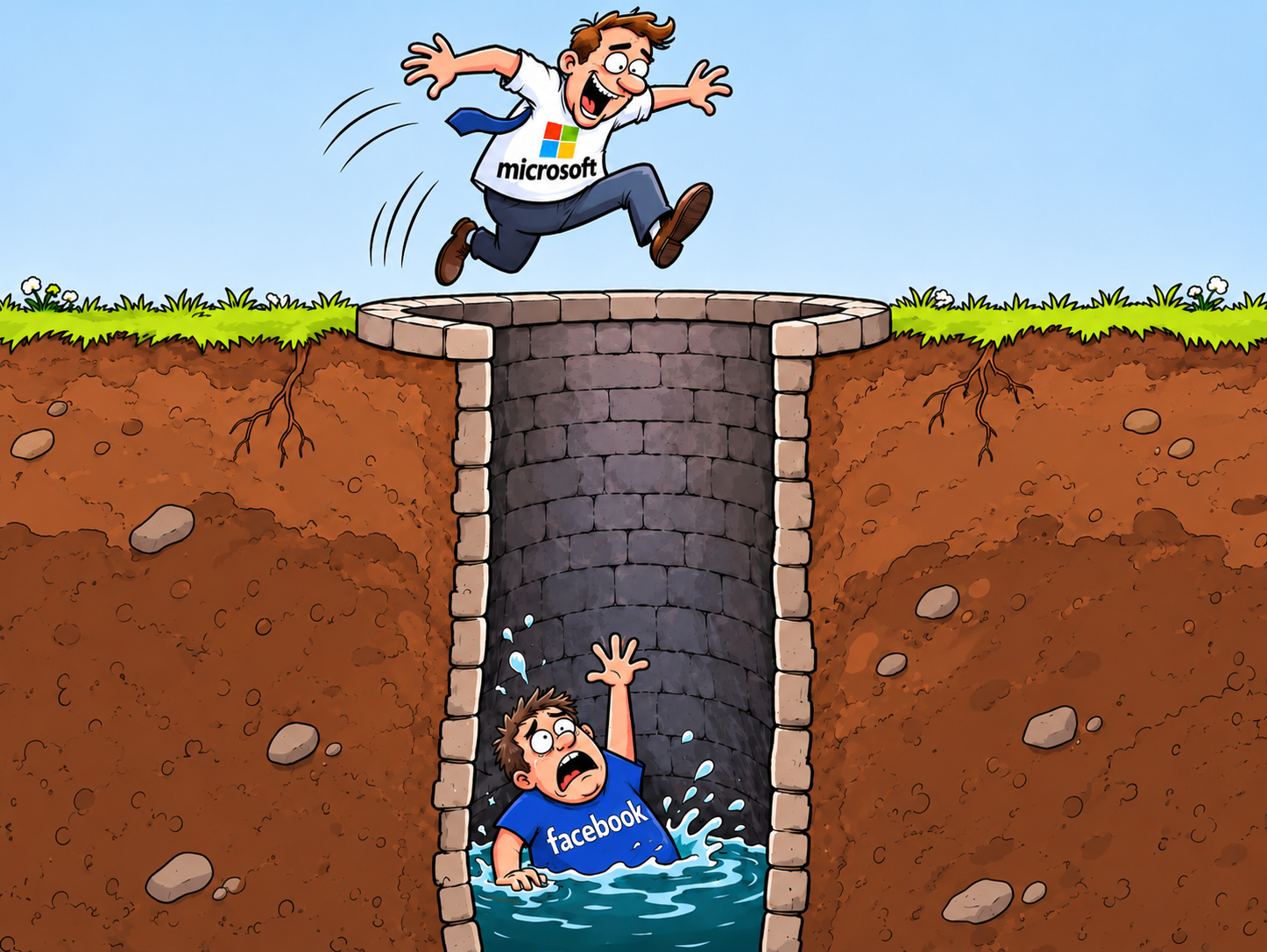
That troublesome BGP again. It seems that, from time to time, a few poorly executed network configurations can bring even the world’s largest IT companies to their knees.
Microsoft’s Friday outage
On 13 November 2026, a significant portion of Microsoft’s services became unavailable. Outlook, Teams, Exchange Online and numerous other Microsoft 365 services experienced problems. According to Microsoft, a fault introduced during an earlier network capacity expansion was exposed by a subsequent configuration change. As a result, serving capacity was lost, and the remaining infrastructure became overloaded.
We do not yet know exactly which network configuration caused the problem. Personally, though, I suspect BGP.
BGP, or Border Gateway Protocol, is one of the internet’s fundamental building blocks. It allows the networks of different providers and autonomous systems to know how to reach one another. If a company changes its BGP configuration incorrectly, it can make entire networks disappear from the internet. The servers are working and the applications are running; it is just that nobody can find their way to them.
Sound familiar?
When Facebook disappeared from the internet
On 4 October 2021, Facebook managed to do something very similar. A faulty network maintenance operation severed connectivity between its own data centres. Its DNS servers detected this as a fault and automatically withdrew the BGP routes leading to them.
Facebook, Instagram and WhatsApp effectively disappeared from the internet.
But I do not think that was even the most interesting part of the story.
DNS can be a shared point of failure too
Facebook also hosted DNS for its own domains on its own infrastructure. When the BGP routes disappeared, DNS servers around the world could no longer resolve Facebook’s domains.
And that caused problems for more than just Facebook’s users.
Countless other websites referenced domains belonging to Facebook. Embedded content, JavaScript libraries, tracking code, authentication services and all sorts of external resources depended on them. Some websites loaded incorrectly or slowly; on others, Facebook login became unusable. Failed DNS queries also placed a significant additional load on the internet’s DNS infrastructure.
In other words, a network failure at a single company affected numerous other services across the internet.
Yet there would have been a fairly simple architectural remedy for the DNS side of the problem.
The authoritative DNS servers serving Facebook’s domains should have been hosted, at least in part, with independent providers. For example, one nameserver could have been in Facebook’s own network and another in a completely independent autonomous system. That way, even if Facebook’s entire network disappeared from the internet, DNS resolution could have remained operational.
Of course, that would not have made Facebook itself work. But at least name resolution would not have collapsed along with it.
Another absurd aspect of the story was that some of Facebook’s own recovery tools also became inaccessible. Engineers eventually had to physically enter the data centres to restore the network.
In other words, they had managed to build a system whose repair infrastructure partly depended on the very system that had broken down.
What has changed in five years?
And now comes the really interesting part.
Out of curiosity, I checked what had changed since then, as more than five years have passed since the incident.
The facebook.com domain still uses four authoritative DNS servers: a.ns.facebook.com, b.ns.facebook.com, c.ns.facebook.com and d.ns.facebook.com.
All of them belong to Meta’s own autonomous system, AS32934.
Based on the publicly visible DNS architecture, there is therefore still no independent nameserver operating in another autonomous system that would keep facebook.com resolvable if Meta’s own network suffered a complete routing outage.
Of course, this does not prove that the 2021 failure could still be triggered in exactly the same way today. Meta may since have built numerous internal safeguards that are invisible from the outside.
The shared network dependency, however, still exists.
The vicious circle of recovery
And there is another interesting question here.
Suppose a configuration error causes Meta’s entire AS32934 autonomous system to disappear from the internet’s routing tables.
The DNS servers become unreachable. If any management system, authentication service or configuration tool needed for recovery also depends on those DNS servers, a vicious circle can easily develop.
The network cannot be restored because the infrastructure needed to restore it is unavailable. And the infrastructure is unavailable because the network is not working.
Of course, a properly designed independent management network and emergency access that does not depend on DNS can prevent this. The question is whether they really are independent.
Back to Microsoft: how far does anycast get us?
And this is where I would return to Microsoft.
DNS for the microsoft.com domain is also provided by the company’s own Azure DNS infrastructure. Microsoft uses a globally distributed, anycast-based system that protects against many local failures.
But what would happen if an incorrect central network configuration simultaneously affected the BGP routes needed to serve DNS?
Anycast is no magic bullet. If every serving location is subject to the same faulty routing control, geographical redundancy alone does not help much.
I am not claiming that Friday’s Microsoft outage was caused by a BGP error. The information currently available does not prove that. What it does show is that a network configuration problem was able to disrupt several critical cloud services at once.
Redundancy or real independence?
To me, the examples of Facebook and Microsoft highlight the same fundamental architectural question.
What is redundancy worth if the redundant systems depend on the same shared infrastructure?
We can have a hundred data centres, thousands of servers, geographically distributed services and automatic failover mechanisms. But if all of them depend on the same critical control point, we still effectively have a single shared point of failure.
It is especially important that the recovery system does not depend on what it needs to recover.
For me, the surprising part of this story is not that an engineer produces a faulty configuration. That can happen anywhere.
It is that the world’s largest technology companies build infrastructures so complex that the consequences of a single configuration error can become global.
And the really interesting question is not how many redundant servers they have.
It is how many truly independent failure domains they have.