
How do birds talk?
What if birds aren’t actually talking to each other?
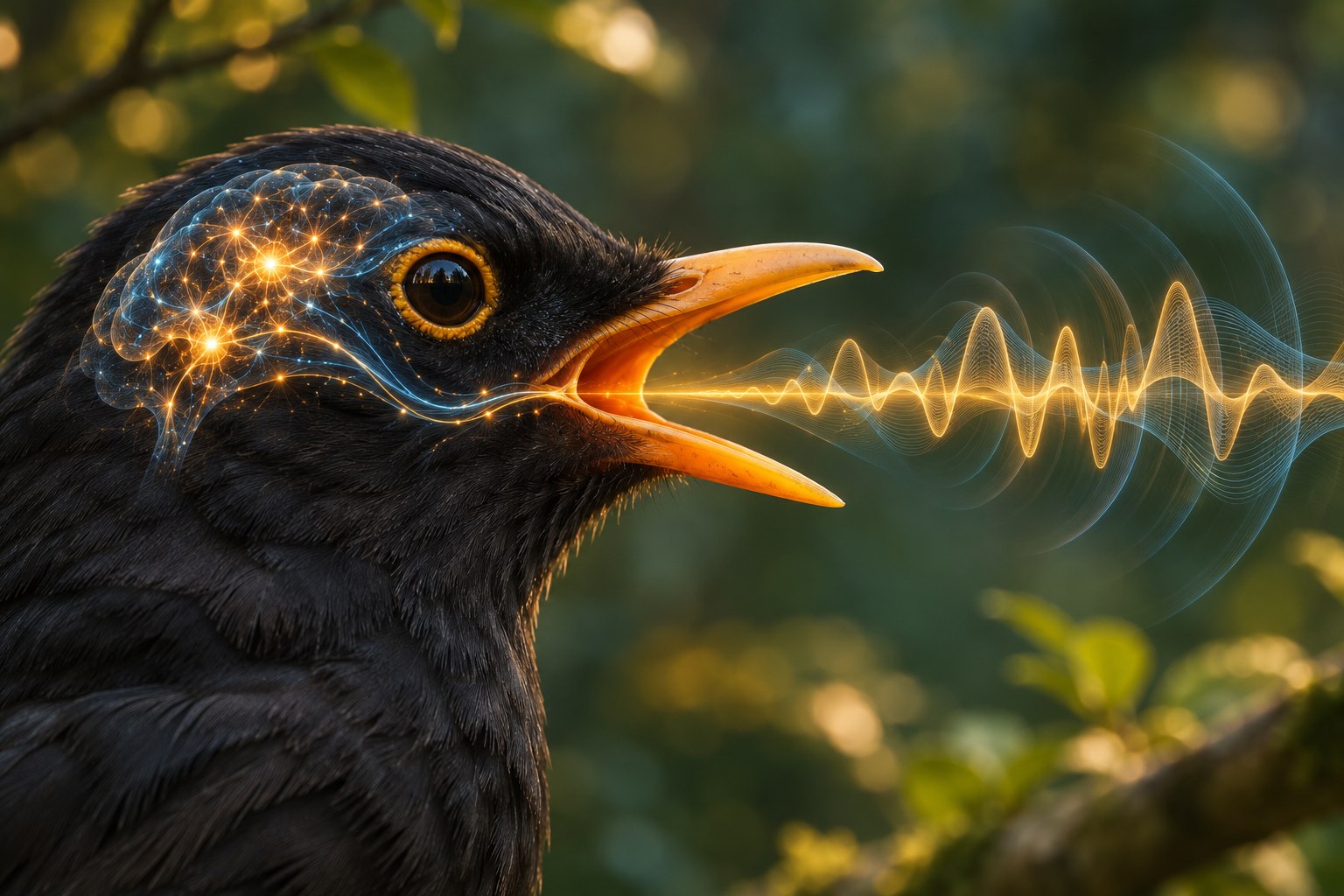
In summer, it’s good to sit out in the garden and listen to the birds. Especially the blackbirds, which can make some quite astonishing sounds. As someone who works in IT, what I often hear in those sounds is the unmistakable screech of a 1990s dial-up modem. One blackbird starts singing a rather peculiar tune that jumps between frequencies. Then, from perhaps a few hundred metres away, another bird answers with similar sounds. It’s as if two computers were trying to connect.
I’ve been wondering for a while what I’m actually hearing when this happens. Two birds having a conversation? Sending each other messages? Or something else entirely?
Do you remember what modems sounded like?
Connecting to the internet in the 1990s was quite a different experience. Your computer used a modem to dial a phone number and, if all went well, a few seconds of ear-splitting squeals and crackling later, you were online. The modem converted digital information into audio signals it could send over an ordinary telephone line. At the other end, another modem converted those sounds back into digital data.
But the two devices couldn’t start sending data straight away. First, they had to agree on a speed, a way to encode the data in the signal, and the other settings they would use. That’s what we call a handshake. Some of those strange sounds were the negotiation itself. The modems sent each other signals, tested the line, and settled on a connection that would work for both of them. And that’s exactly what comes to mind when I listen to blackbirds.
Could birds be doing a handshake too?
My first thought was that something similar might be happening between the birds. One starts to sing, the other replies, and by varying their tunes and frequencies, the two establish some sort of connection. That in itself wouldn’t be especially surprising. Birds use sounds to announce their presence, defend their territory, find a mate, and warn one another of danger. Birds answering each other’s songs is a familiar phenomenon too.
But something else started to bother me. Blackbird song is remarkably varied. The pitch, rhythm, timbre, and frequency modulation change almost constantly. Sometimes it sounds like something from a futuristic synthesiser. Why make sounds this complex? It could simply be that they have a rich repertoire of learned melodies. But what if we’re looking at the problem from the wrong end? What if we started with what produces the sounds in the first place?
What if a bird is singing its thoughts?
Imagine a blackbird’s brain continually processing what’s happening around it. The bird sees trees, notices movement, hears other birds, and watches for threats. All of that produces a constantly changing pattern of activity in its brain. My hypothesis is that, in some songbirds, the sounds they make could be tied more directly to that internal state than we usually imagine.
What if, instead of picking a tune it has learned to communicate something, the bird turns part of its current neural state into sound? What we hear as song might then be an acoustic representation of an internal state that keeps changing, with no need for words or a sequence of predefined messages.
And this is where it gets interesting. What happens when another bird hears that sound? Its auditory system processes the frequencies, rhythm, and patterns, triggering neural activity in its own brain. If the neural mechanisms for producing and perceiving sound are linked in the right way, the melody could, in principle, evoke a state in the second bird’s brain that resembles the first bird’s. So what the bird picks up could be part of the internal state that produced the tune, even if it never learns to sing the tune back.
Two brains keeping time through sound
When I looked into this, I came across some fascinating research. In a 2019 paper in Nature Communications, researchers studied brain activity in birds singing duets in the wild. They found that when one bird joined in, its voice changed the rhythm of the neural activity that prepares the other bird to sing. The two birds’ neural activity became coordinated in time. The researchers described how the two brains worked together as a distributed neural network that organised the timing of the duet.
Other research has shown that the systems responsible for hearing and producing sounds are closely connected in songbirds. Some neurons respond both to songs the bird hears and to its own vocalisations. These studies leave open the question of whether birds broadcast their thoughts. Much of the neural activity measured is tied to controlling vocal production. What the studies do show is that the sound of one bird can directly influence song-related activity in another bird’s brain. And to me, that’s fascinating in itself.
Could an entire forest have a shared consciousness?
Let’s take the thought experiment a little further. Say one blackbird spots a predator. The threat changes its brain state, which in turn affects the sounds it makes. Other blackbirds nearby hear those sounds, and a similar threat-related state arises in their nervous systems. They make sounds too, which more birds hear. Information can spread through the forest before every bird has seen the predator for itself.
There’s evidence of alarm calls spreading information like this. Birds can learn from the alarm calls of other individuals and even other species. In a 2024 study, wild birds learned that an unfamiliar sound signalled danger from their neighbours’ reactions. But I’m taking the idea a little further. What if some species of birds are constantly synchronising part of their internal states with one another?
The birds in different parts of the forest could then form a kind of distributed neural network. Each bird would have its own brain, and through sound they would keep influencing one another’s activity. From a computing perspective, that would be an intriguing architecture. It could work without a central controller, shared memory, or even a persistent connection. Each node would broadcast part of its own state while receiving signals from the other nodes. The network as a whole could develop a shared state that changes from one moment to the next.
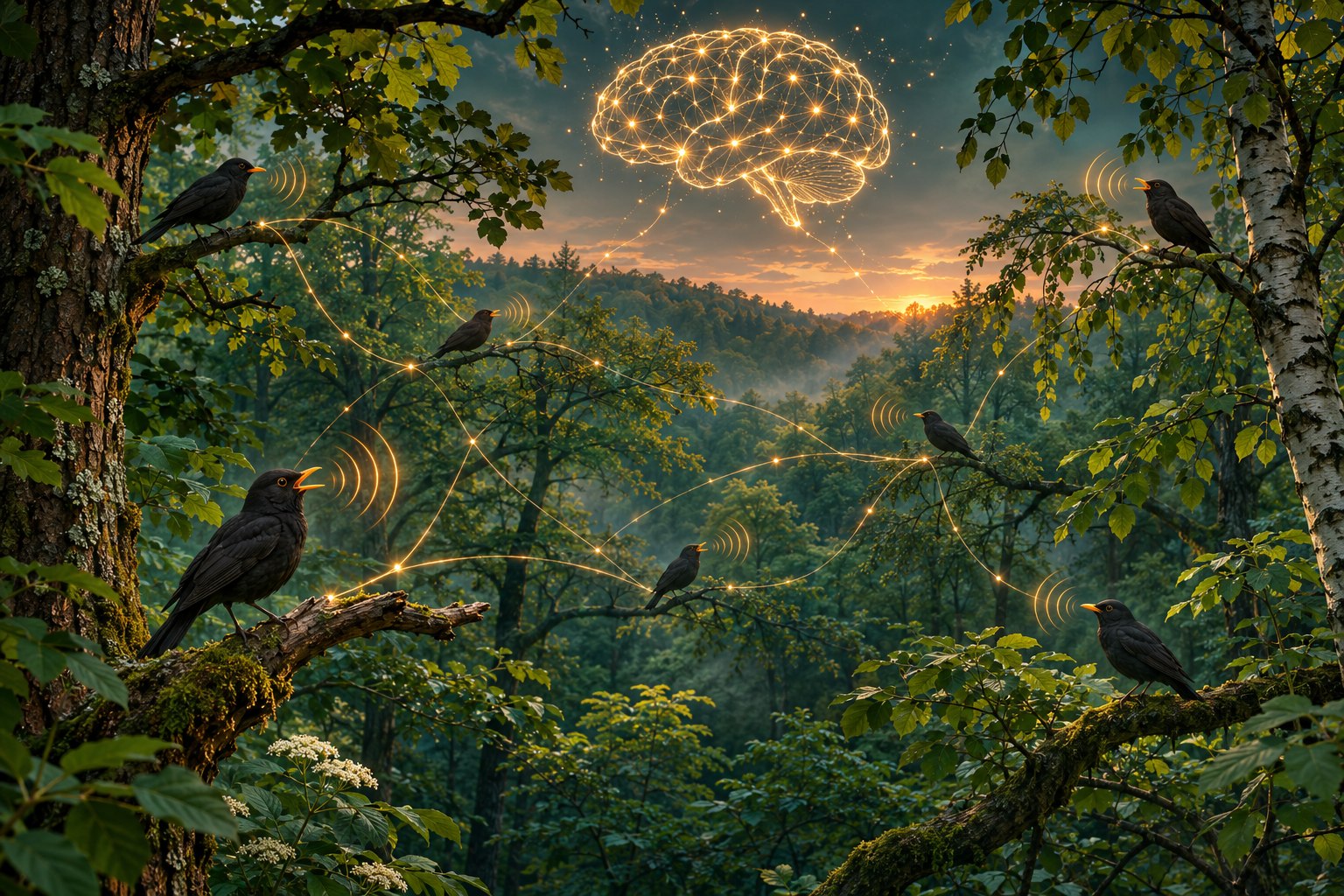
Whether we can call that a shared consciousness is a question for philosophy and neuroscience. Synchronised neural activity alone tells us little about whether there is a shared subjective experience. A collective information-processing system would be much easier to study, and research on animal communication networks is already moving in that direction.
Could artificial intelligence help us figure it out?
The experiment I’d like to try would use several microphones in a forest to separate the sounds of individual birds and track how their songs change in response to each other. We could use the recordings to train a multimodal artificial intelligence model to predict how a particular bird’s song will continue and how the acoustic activity of the community as a whole will change.
With video as well, we could see whether changes in sound let us anticipate the birds’ movements or behaviour, or events in their surroundings. A model like this might pick up patterns the human ear can’t distinguish. We could learn a lot even if we still couldn’t translate a blackbird’s song into human language.
Maybe what we need to understand birdsong is a model that can reconstruct the ever-changing neural states behind the sounds. A dictionary would tell us much less.
What if we’ve been thinking about birdsong the wrong way?
We humans think, choose words, put sentences together, and share our thoughts. A different kind of nervous system might have evolved a completely different way of sharing information.
Maybe when I’m sitting in the garden in summer, listening to the blackbirds answer one another, I’m hearing a tiny fragment of my neighbourhood thinking out loud.
Sources and related research
- Hoffmann et al. (2019). Duets recorded in the wild reveal that interindividually coordinated motor control enables cooperative behavior. Nature Communications.
- Bauer et al. (2008). A Synaptic Basis for Auditory–Vocal Integration in the Songbird. The Journal of Neuroscience.
- Szymkowiak (2024). Auditory risk recognition is socially transmitted across territory borders in wild birds. Animal Cognition.
- Szymkowiak (2022). Eavesdropping on conspecific alarm calls links birds across territory borders into a population-wide information network. Animal Behaviour.
- Magrath et al. (2015). Wild Birds Learn to Eavesdrop on Heterospecific Alarm Calls. Current Biology.
Broadcasting neural states and sharing a consciousness are hypotheses I explore in this thought experiment. The research cited above supports neural coordination, vocal learning, and information sharing among birds. The idea of a shared consciousness belongs to the thought experiment.