
What if we have misunderstood quantum mechanics all along?
What if the strange world of quantum mechanics is an expression of much simpler wave mechanics? A personal hypothesis about electromagnetic vortices, its limitations, and the possibility of simulation.
I have a long-held theory about how the world works that, to put it mildly, does not agree with the generally accepted model of modern physics. I am not claiming to be right, but for some time I have been wondering whether the world might be much simpler than the way we describe it today.
Quantum mechanics is extraordinarily successful mathematically. Its predictions work, experiments confirm them, and a great deal of our technology relies on it. Yet I find it unsettling that, when explaining physical reality, we arrive at concepts such as wave–particle duality, superposition, wave function collapse, or quantum entanglement.
What if some of these are not fundamental properties of nature, but consequences of the mathematical description of a deeper physical mechanism?
Matter as a wave structure
In my view, the electromagnetic field is the foundation of the universe. There are no elementary particles in the traditional sense, only electromagnetic waves and their various configurations.
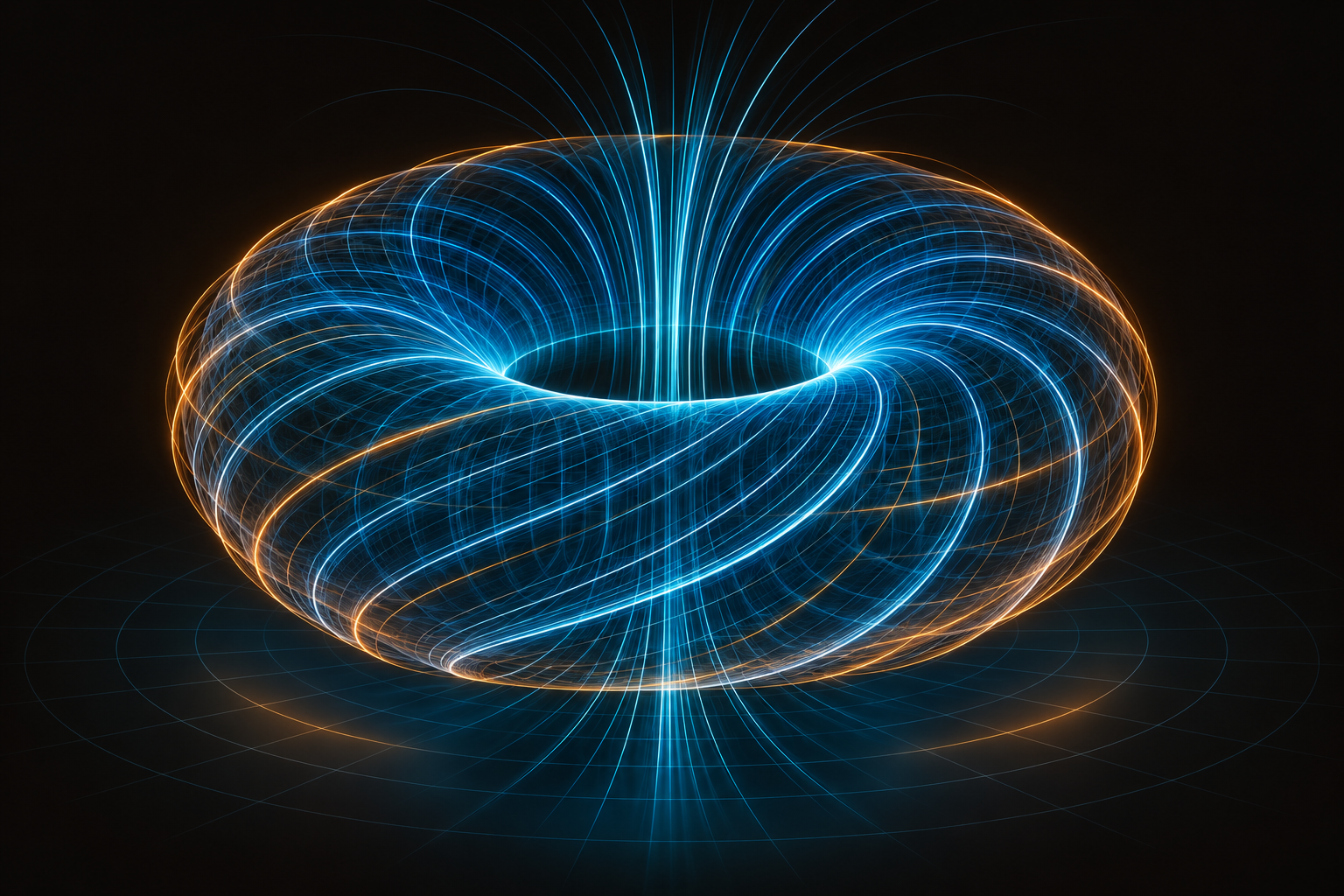
I imagine the smallest building blocks of matter as stable, localized electromagnetic vortices: wave structures that close in on themselves and can remain in one place even as the field within them constantly changes.
Something like a whirlpool that can stay in one place while the water inside it keeps moving. Of course, the electromagnetic field is not water, and the vortex is only an analogy.
In this model, the electron is neither a tiny ball nor a mysterious object existing in a probability cloud. The stable electromagnetic vortex itself is the electron. Charge, spin, and even mass could arise from the geometry, energy, and dynamics of the wave structure.
Where could quantization come from?
The next question is the quantization of energy.
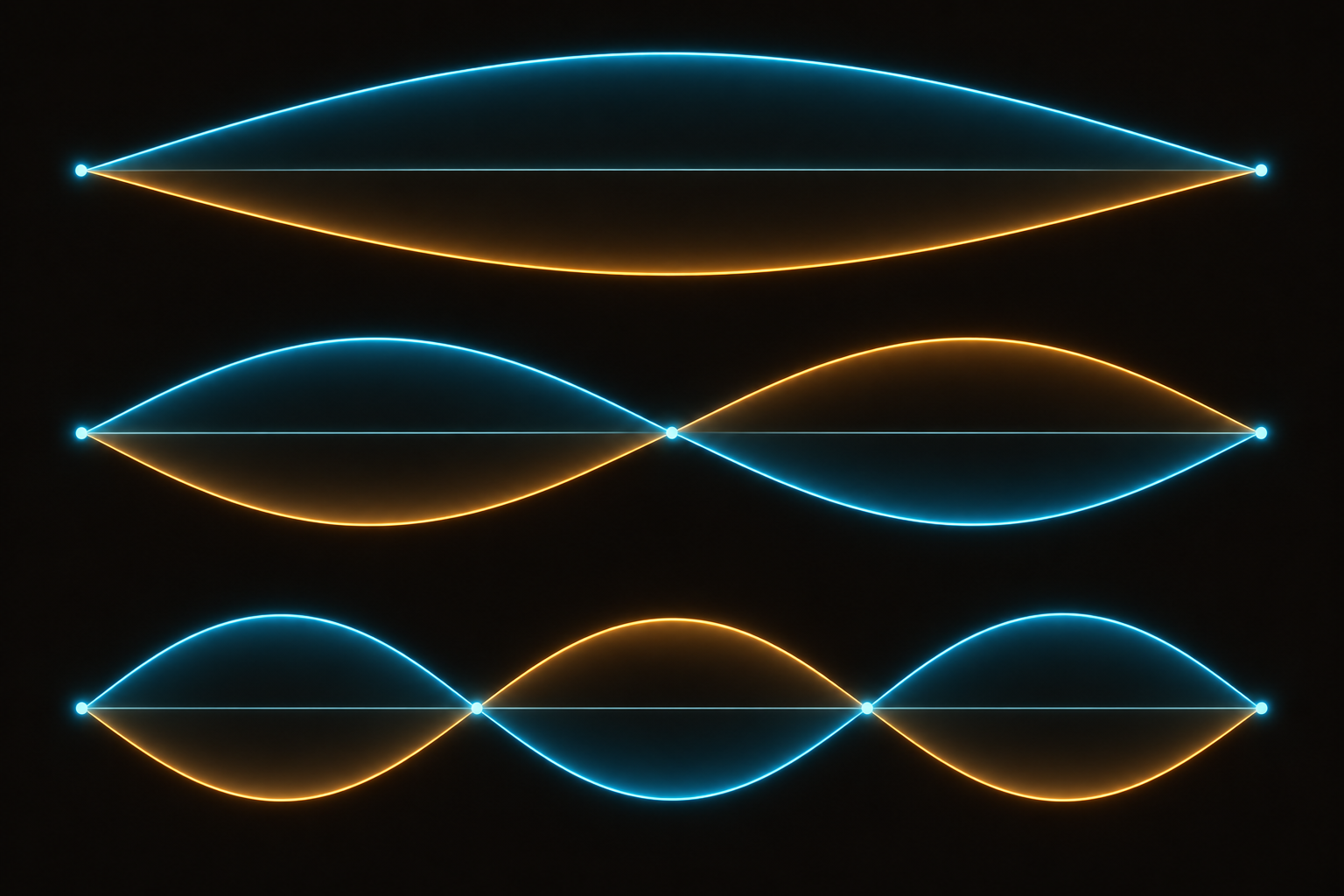
According to quantum mechanics, certain systems can exist only at specific energy levels. But this alone does not require quantum mechanics. A classical resonator cannot support just any standing wave either: only frequencies that satisfy the system’s geometric and physical conditions are stable.
Why could electromagnetic vortices not work in a similar way?
If such a structure has only certain stable states, an incoming electromagnetic wave could change its state only under particular conditions. An observer would simply see the system absorbing or emitting a specific amount of energy.
In other words, quantization would not necessarily be a property of the propagating electromagnetic wave, but of the structure with which it interacts.
From this perspective, even the concept of the photon can be questioned. Just because a detector registers a single localized event does not necessarily mean that the radiation causing it arrived as an individual particle. Perhaps it is only the detector that can undergo discrete changes of state.
Of course, simple classical electromagnetic theory does not explain every photon experiment. Single-photon interference and photon correlation measurements present serious obstacles to such an idea. They cannot be ignored.
Randomness and entanglement
The probabilistic nature of quantum mechanics raises similar questions.
I find it difficult to accept that nature operates in a fundamentally random way. It seems much more plausible to me that we are seeing the behavior of an extremely complex but deterministic system whose variables we simply do not fully know.
That does not make me right, of course. Experimental violations of Bell inequalities, for example, rule out a large class of local hidden-variable models. A deterministic alternative would also have to give a precise explanation of these results.
I am particularly skeptical about quantum entanglement. I am not disputing the observed correlations, but questioning whether their mathematical description also explains their physical mechanism. What interests me is exactly what happens in space when we measure such correlations between two systems.
The limits of the hypothesis
There is, however, a fundamental problem with my entire idea.
The standard Maxwell equations in a vacuum are linear, and on their own do not provide the stable, self-contained vortices I am assuming. Nor can the properties of known particles and the other fundamental interactions simply be declared electromagnetic phenomena.
In other words, my theory is currently more of a hypothesis than a genuine physical model. To be taken seriously, it would need specific field equations and testable results.
The next step: simulation
And this is the part that really interests me as an engineer.
Why not simulate it?
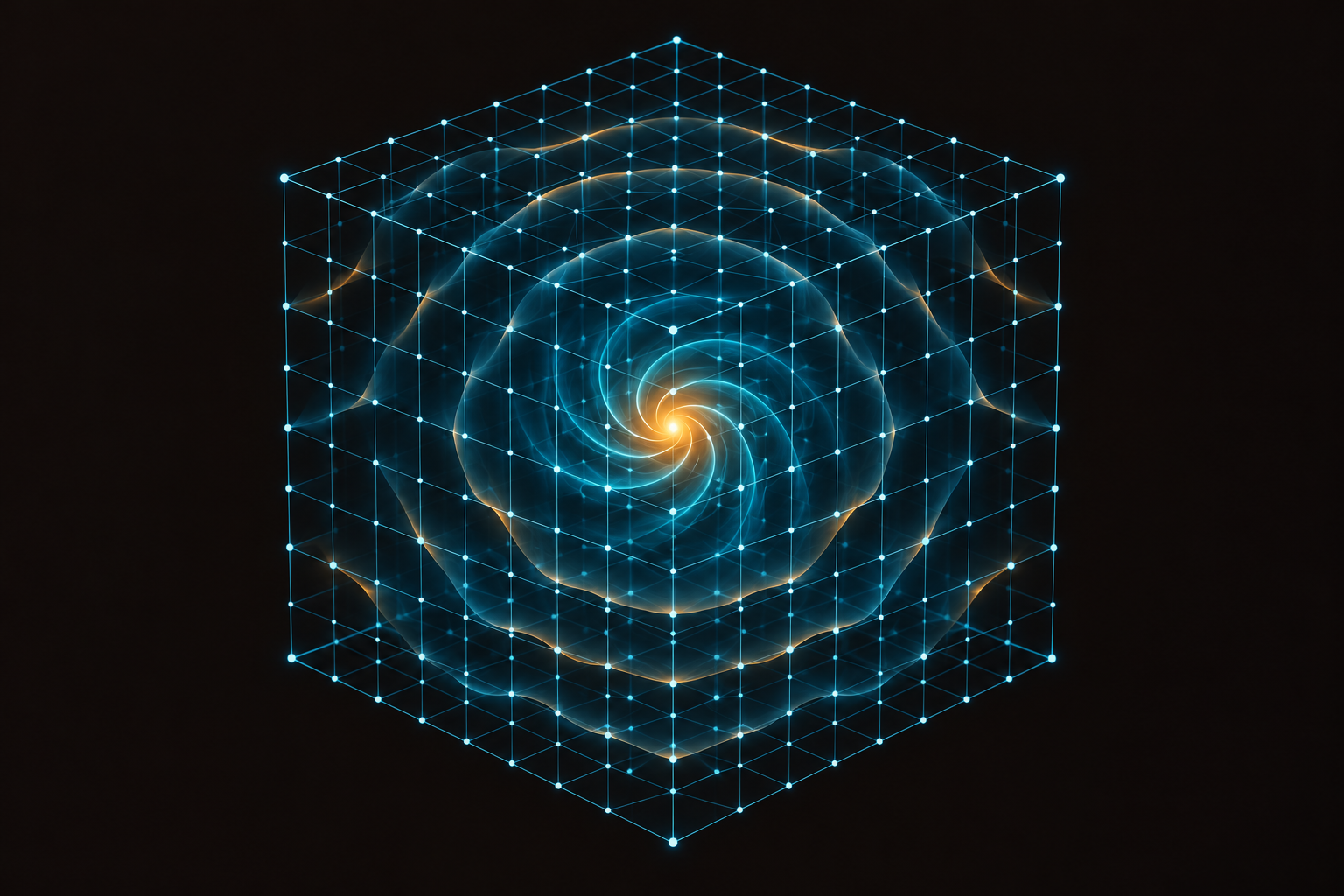
The evolution of the electromagnetic field over time can be modeled numerically on a three-dimensional spatial grid. Today, GPUs provide enough computing power to investigate quite complex systems of field dynamics.
The first step would be to find out whether a stable, localized electromagnetic vortex can be created under suitable physical conditions. If so, we could examine its states, interactions, and responses to incoming waves.
The next step would be to see whether the simulation can reproduce phenomena that we currently describe using quantum mechanics.
And I have an even bolder idea.
If quantum phenomena really were underpinned by classical field dynamics, we could in principle try running quantum computing algorithms in such a simulated system. We could compare the results with those of real quantum computers.
Of course, we can already simulate quantum systems on classical computers. The real question is not whether it is possible, but how the computational cost scales. If we get the same exponential growth, we have not made much progress. If it scales substantially better, however, that would be an interesting result.
What does a working model tell us?
There is one fundamental question behind this whole line of thought.
Just because a mathematical model predicts measurement results with extraordinary accuracy, does it necessarily describe correctly what is physically happening?
The history of physics is full of models that worked well in their day, only to turn out later to be special cases of a more general theory.
Perhaps that is also the case with quantum mechanics. Or perhaps it is not.
I do not think I have solved the problems of physics in one stroke with an idea based on electromagnetic vortices. For now, I do not even know whether the structures I am proposing can exist mathematically.
But in science, I believe what matters is not how unusual an idea is, but whether it can be turned into a testable model.
And if the simulation shows that the whole thing is nonsense, at least I will have learned why.
Until then, one question keeps nagging at me: what if there are actually no particles, no photons, and the strange world of quantum mechanics is merely an expression of much simpler wave mechanics?
What if, ultimately, everything is just waves?