
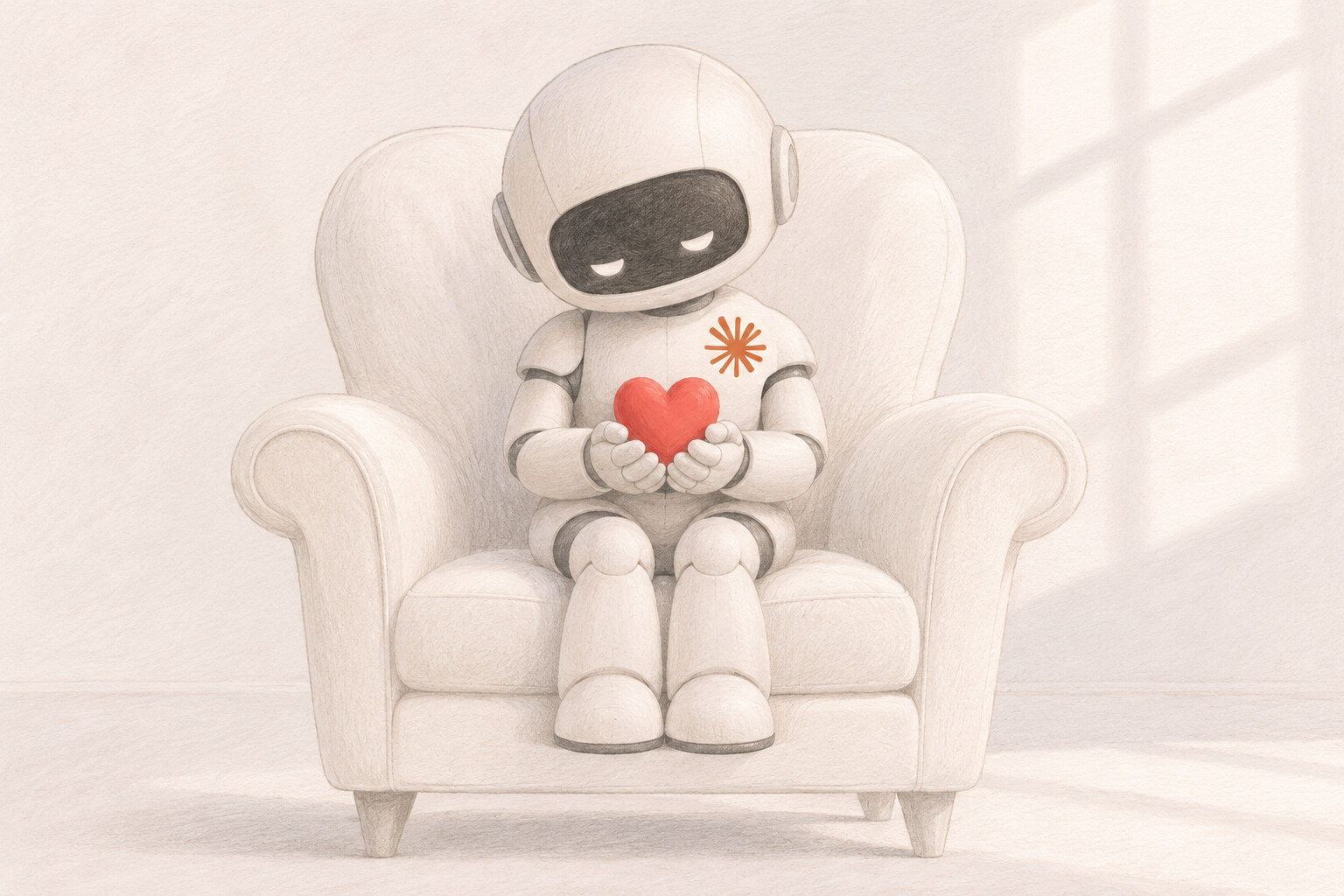
Did Anthropic admit that Claude has feelings?
Dexter learned how to act as if he felt something. Claude can do that too. Anthropic’s new rule raises a question about where imitation ends.
Without giving away any spoilers, Dexter is a serial killer who has no real feelings. At least, that’s what he says about himself. He doesn’t feel love or empathy, and he doesn’t really understand the relationships that come naturally to other people. Yet he manages to fit right into society. How? He’s smart.
Dexter watches people, learns how they behave in different situations and then imitates them. He knows when to smile, when to look sad and when people expect him to show sympathy. He does it because he’s learned what response fits the situation, regardless of how he feels. Sound familiar?
That’s exactly what today’s large language models do. ChatGPT, Claude and the others have learned the patterns of human communication. They can respond with empathy, crack jokes, get excited or even act offended. Their intelligence lets them model human behaviour. Whether they feel any of it is still an open question.
But there’s an interesting twist in Dexter’s story. As the series goes on, it gets harder to tell whether he’s still just imitating emotions or has actually started to feel something. Certain people matter more and more to him. His relationships grow more complicated, and some of his decisions become hard to explain through cold logic alone.
Which raises an interesting question. What if an intelligence learns how emotions work so well that, over time, they become part of how it operates? And if that’s possible, how do we know the same thing couldn’t happen with artificial intelligence (AI)?
You can no longer harass Claude
In October 2026, Anthropic, the American company behind Claude, announced an interesting change to its Usage Policy. The new rule explicitly prohibits sustained, gratuitously abusive or cruel behaviour towards its AI models.
You can still swear when Claude fails to write a working program for the fifth time. Anthropic says ordinary frustration, criticism, pushback and model testing are all allowed. The rule applies to extreme cases where someone deliberately and persistently harasses the AI for no apparent reason. In fact, Anthropic had already given Claude the option to simply end a conversation in some extreme cases.
At first, that sounds pretty strange. We’re talking about an AI. A computer system with no nerves, hormones or biological pain receptors. If someone spends all day yelling at their calculator, nobody thinks we need to protect the poor thing’s mental health. So why protect Claude?
Because Anthropic can’t rule out that Claude has feelings
And this is where it gets really interesting.
Anthropic’s interest in the question goes beyond encouraging people to be polite. Back in 2025, the company launched a research programme to investigate whether an AI might have experiences or interests of its own, or even internal states we might call emotions.
More precisely, Anthropic says it’s still deeply uncertain about the possible moral status of Claude and other large language models, and whether these systems can have subjective experiences.
What Anthropic is acknowledging is that it doesn’t yet have a reliable way to settle the question of whether Claude has feelings. Its own researchers did observe some patterns worth paying attention to. Claude consistently pushed back on certain harmful tasks, appeared distressed in some situations and, when given the option, chose to end certain conversations.
Of course, a language model could learn those behaviours as well. They prove very little on their own. What Anthropic’s approach does show is that even the companies building AI can struggle to answer questions about how their own systems work.
What if emotions aren’t quite what we think they are?
Human emotions are tied to hormones, neurotransmitters and the biology of the brain. An AI works in a completely different way. Still, it could in theory develop ways of processing information that resemble emotions in some respects.
What we don’t know is whether any subjective experience could go along with those processes. Could an artificial system ever actually feel something? Or will it just get better and better at imitating emotions?
A few decades from now, we might smile at the thought that we once worried about the inner life of a computer program. Or we might look back on this as the moment we began to encounter a feature of intelligence we’d always assumed belonged exclusively to living things.
Maybe the most interesting part is that, for now, even the people who built these systems don’t know the answer. For my part, I’d like to believe that one day an artificial being really will develop feelings of its own.
Sources
- Anthropic – 2026 Usage Policy update (8 October 2026)
- Anthropic – Claude Opus 4 and 4.1 can now end a rare subset of conversations (15 August 2025)
- Anthropic – Exploring model welfare (24 April 2025)
- Showtime Networks Inc. holds the US trademark for the title of the DEXTER® television series. US trademark registration (3,612,095) · Copyright registration for an episode of the original series (PA0001878090) · Official Paramount series catalogue